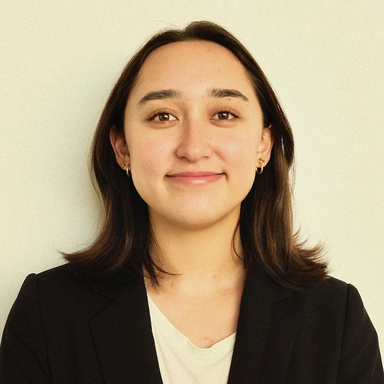
Klaertje Hesselink (BS chemical engineering ’26) has received a Fulbright Study/Research grant to Germany for the 2026–27 academic year.
Hometown: Cedar Falls, Iowa
Could you give us a synopsis of what you’ll be doing with your Fulbright?
I will be working at the Technical University of Munich conducting environmental chemistry research in the Bavarian Alps. I will collect and analyze permafrost and glacial runoff to identify waste contaminants released as the alpine region thaws. My project focuses on installing time-weighted sampling systems near the Zugspitze to monitor water composition in real time and generate foundational data for a larger physics-based computational model. This model will help predict landslides, changes in water quality, and related risks to support better management and improved safety in the Bavarian Alps.
How do you envision this will influence your life or future career?
I am interested in research focused on designing methods for cleaner energy and water. As a chemical engineer whose work has largely centered on catalyst synthesis, this project will be my first opportunity to engage directly in field-based research. I believe this experience will be a pivotal step in bridging laboratory approaches with environmental testing, allowing me to apply laboratory insights to real-world environmental challenges in a meaningful way.
I envision this experience shaping my career toward an interdisciplinary space where chemical engineering, environmental engineering, and public policy intersect. The most pressing challenges in clean energy and water access cannot be solved within the boundaries of a single discipline, and I am eager to collaborate across fields to develop solutions that are both scientifically rigorous and practically applicable.
What advice do you have for students interested in applying for a Fulbright?
Start as early as possible. I attended my first Fulbright workshop during my sophomore year with no specific plans or expectations, just a desire to learn about the process. By my junior year, I was ready to approach the application seriously. Because I already understood the grant structure, I was able to focus more on refining my research goals and articulating why Germany was the best place to pursue them.
For students applying for a study/research grant, securing your host affiliation as early as possible is essential, and you should plan to go through multiple iterations of your research proposal. Finding a host institution was the most time-consuming step for me, so resolving that early can significantly reduce stress later in the process.
Were there experiences at Iowa that inspired you to pursue a Fulbright?
During the spring semester of my junior year, I took the course Environmental Politics and Indigeneity taught by Professor David Greenwood-Sanchez. For our final project, we wrote a mock Fulbright proposal, an experience that strongly motivated me to apply for a Fulbright the following summer. Professor Greenwood-Sanchez reviewed multiple drafts and consistently challenged me to think critically about how to design a compelling and feasible project. Without that trial run, the Fulbright application process would have felt much more daunting.
Are there individuals you’d like to thank for their investment in this process?
I am incredibly grateful to the mentors who have shaped my journey and made this application possible. My research path began with the guidance of Professor Giannis Mpourmpakis at the University of Pittsburgh and my graduate mentor, Dr. Maya Salem, both of whom fostered my enthusiasm for research. I am equally thankful to Professor Eranda Nikolla and Kunal Velinkar at the University of Michigan, who introduced me to experimental research and expanded how I think about my work. Through the Department of Energy Summer Undergraduate Laboratory Internship, Dr. Wilson McNeary, Professor Chae Jeong-Potter, and Dr. Alex Hill further developed my experimental skills and strengthened my technical writing, which was essential for my research proposal.
At the University of Iowa, I am grateful to my research mentor, Professor Tori Forbes; Dr. Vidumini Samarasiri; Emma Markun; and the entire Forbes lab, whose consistent support and collaboration have meant more to me than I can express.
I would also like to sincerely thank my letter writers, Professor Mpourmpakis, Professor Forbes, and Dr. Tawny Tibbits, whose advocacy was essential to this application. I am grateful as well to Professor David Greenwood-Sanchez, Professor Jeffrey Dawson, and my father for carefully reviewing multiple iterations of my application.
I would like to extend additional thanks to Professor David Cwiertny for introducing me to my host affiliation.
Finally, this process would not have been possible without Karen Wachsmuth and Sylvia Dean. Their dedication, encouragement, and willingness to meet with me throughout the summer meant everything to me, and I am deeply appreciative of their continued support.
EXPLORE THE MANY FUNDING OPPORTUNITIES OPEN TO UI STUDENTS AND ALUMNI
International Programs (IP) at the University of Iowa (UI) is committed to enriching the global experience of UI students, faculty, staff, and the general public by leading efforts to promote internationally oriented teaching, research, creative work, and community engagement. IP provides support for international students and scholars, administers scholarships and assistance for students who study, intern, or do research abroad, and provides funding opportunities and grant-writing assistance for faculty engaged in international research. IP shares their stories through various media, and by hosting multiple public engagement activities each year.